How to Find a Distributor in Canada
What international manufacturers should look for in a Canadian distribution partner — and the questions and warning signs that justify deeper diligence before signing.
Key Takeaways
- Define what “distributor” means in the specific relationship — passive wholesale coverage, active market development or something in between can all be valid.
- Judge candidates on six dimensions: product fit, Canadian market knowledge, route-to-market capability, operations, economics and alignment.
- Ask how they would launch your product specifically; the quality of that answer reveals more than any capability list.
- Treat exclusivity requests without a launch plan, and promises of guaranteed national placement, as reasons for deeper diligence.
- Score candidates qualitatively across nine dimensions — including regulatory readiness where applicable — and weight what your product depends on most.
In This Guide
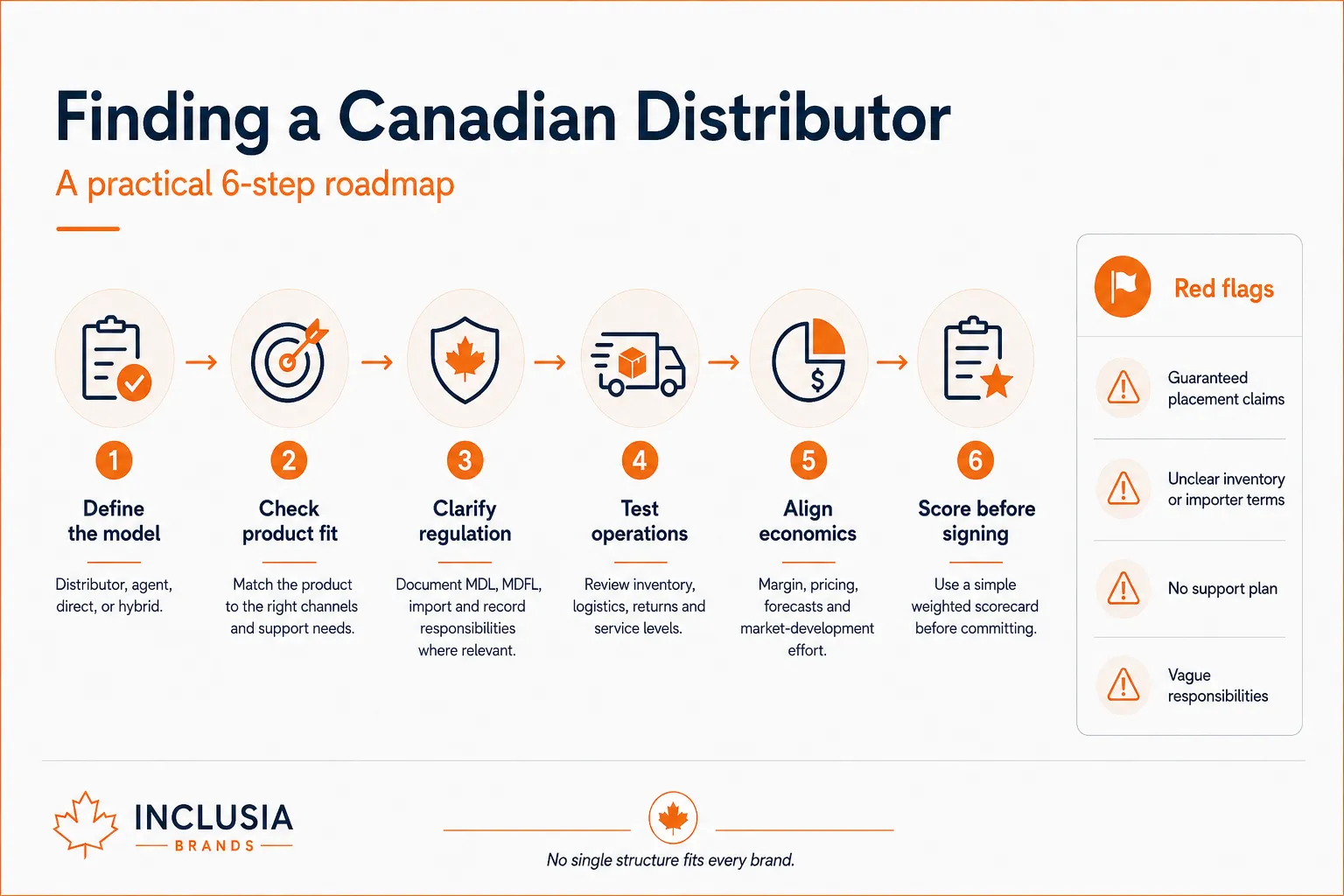
Finding the right Canadian distributor takes more than identifying a company willing to buy inventory. The manufacturers who build durable Canadian businesses evaluate six things before signing anything: product and category fit, Canadian market knowledge, route-to-market capability, operational capacity, economic alignment and clarity about how actively the partner will develop the market.
This guide walks through each of those dimensions, the questions worth asking a prospective partner, the warning signs that justify deeper diligence, and a practical scorecard for comparing candidates.
First, Define What “Distributor” Means in This Relationship
“Distribution” covers a wide range of commercial behaviour, and the differences matter more than the label. Arrangements sit on a spectrum:
- Wholesale / resale distributor — buys and resells product, with limited market-development responsibility.
- Full market-development distributor — may take on inventory, importation, ecommerce, channel development, customer support and ongoing market development.
- Specialist distributor — focused on categories that require product knowledge, education or specialized buying pathways.
- Hybrid structure — responsibilities divided between the manufacturer and the local partner by channel, region or stage.
Different structures can be valid for different products. The label matters less than documenting who owns inventory, importation, customers, support, market development and commercial risk. Understand whether the candidate is offering passive wholesale coverage, active market development or something in between — and whether that matches what your product needs. For a deeper comparison of the models, see Canadian distributor vs sales agent.
Where to Find Canadian Distributor Candidates
- The Canadian Importers Database — the Government of Canada maintains a searchable database of companies importing goods into Canada, organized by product, city and country of origin. It is a practical way to identify who already imports products like yours.
- Industry associations and member directories — category associations often publish supplier and distributor directories.
- Trade shows and conferences — category events are where active distributors scout new lines.
- Specialist distributor portfolios — review the brand portfolios of distributors already operating in your category and adjacent ones.
- Working backwards from the shelf — identify Canadian retailers, clinics or institutions carrying adjacent products and ask who supplies them.
- Targeted research — LinkedIn and business-development outreach to named distribution companies, rather than open calls.
Finding candidates is rarely the hard part. The rest of this guide is about the harder step: evaluating whether a candidate can actually build your Canadian market.
Start With Product-Market Fit
The best distributor for someone else's product may be the wrong distributor for yours. A partner who excels at moving high-volume consumer goods through mass retail may have no relevant capability for a specialized product that depends on professional recommendation or customer education. Ask what the candidate's portfolio has in common with your product — in customer, channel and complexity, not just category name. A focused specialist may offer advantages where product education, channel knowledge or customer support are important; a broader distributor may be stronger where scale and general retail coverage matter.
Evaluate Canadian Market Knowledge
Canada should be evaluated as its own commercial market, even where US infrastructure already exists. A credible Canadian partner should be able to speak concretely about:
- Buyers — who actually purchases the product in Canada and who influences that decision.
- Geography — how they serve a market where population is concentrated in a few regions but customers are national.
- Ecommerce — how Canadians research and buy in the category, and what domestic fulfilment expectations look like.
- Specialized channels — where clinical, professional or specialty-retail routes matter and how they are developed.
- Quebec and localization — where French-language and other localization considerations apply to the product. Manufacturers should confirm the Canadian requirements applicable to their specific product and circumstances.
The evidence for the Canadian opportunity itself lives on Why Canada, and the full sequence on entering the Canadian market.
Evaluate Route-to-Market Capability
Be cautious of the phrase “national distribution” offered without detail. The useful question is not whether a partner can theoretically reach every channel, but whether they can develop the channels that matter for your product. An adaptive product may depend on professional awareness before retail placement means anything. A consumer-ready product may need strong ecommerce and customer support far more than clinic relationships. Ask the candidate to describe the route to market they would build for your product specifically — and why. The quality of that answer reveals more than any capability list.
Ask Who Owns Canadian Regulatory Responsibilities
Where the product is regulated, manufacturers should understand who is responsible for classification, licensing, importation, records and other applicable Canadian requirements. The answer varies by product and distribution structure. For medical devices, Canadian entry can involve both device-level MDL requirements and establishment-level MDEL requirements — see MDEL vs. MDL in Canadian medical-device distribution.
Assess Operational Capability
Market development fails without operational follow-through. Confirm how the partner handles inventory planning and forecasting, domestic fulfilment and delivery timelines, returns, customer service coverage and communication back to the manufacturer — and be specific about structure: Where will inventory sit? Who owns and finances it? Who acts as importer where relevant? Who handles returns, and what service level is realistic? How are stockouts handled and forecasts shared? Not every distributor owns inventory, and the answers shape how Canadian customers experience your brand.
Understand the Economics
Distribution economics vary by category, product complexity, support requirements and channel mix, so resist anchoring on a single “standard” margin figure. Evaluate the full structure: distributor margin, retailer or channel margin where relevant, freight, duty and tariff treatment, inventory risk, marketing investment, returns, support burden, currency and payment terms. What matters is that the structure is explicit and aligned — who owns inventory and carries inventory risk, who funds market development, how pricing is governed, and how both parties share the cost of building the market while volumes are small. A partner who avoids specifics on economics is signalling how the relationship will run.
Questions Manufacturers Should Ask
- What products and buyers do you understand best?
- How would you evaluate our product for Canada?
- Which channels would you prioritize for this product, and why?
- What would the first 6–12 months actually look like?
- Who imports the product?
- Who owns and finances inventory?
- Who invoices Canadian customers?
- Who handles ecommerce, returns and customer support?
- What regulatory responsibilities sit with each party?
- What market-development investment is expected from both sides?
- What sales, inventory and market information will we receive, and how often?
- How are performance, exclusivity and exit handled?
A serious candidate will have answers, and better ones will have questions of their own about your product, positioning and expectations. Not every answer needs to follow one preferred model — what matters is that the answers are specific and internally consistent.
Warning Signs
- Requests exclusivity before responsibilities and a launch plan are clear.
- Promises guaranteed national retail placement.
- Cannot describe your product's Canadian buyer or explain the channel logic.
- Vague on economics.
- Vague on inventory and import responsibilities.
- Unwilling to document reporting and performance expectations.
- No product-support plan in a category where support matters.
- Takes on every unrelated category without a clear model.
Any one of these is worth probing. Several together justify deeper diligence before signing a long-term or exclusive arrangement.
A Distributor Evaluation Scorecard
Score each candidate qualitatively — strong, adequate or weak — across nine dimensions:
- Category and buyer fit — relevant experience with comparable products and buyers.
- Canadian market understanding — demonstrated, not assumed from US experience.
- Channel fit — credible access to the routes your product actually needs.
- Operational capability — inventory, fulfilment, returns and service.
- Regulatory readiness where applicable — clarity on who owns which Canadian responsibilities.
- Market-development capability — evidence of building demand for other brands, not just fulfilling it.
- Communication and reporting — quality and responsiveness during the evaluation itself.
- Commercial economics — a transparent structure both sides can sustain.
- Strategic alignment — shared expectations on pace, investment and what success looks like.
Weight the scorecard according to what the product actually requires — the weighting is judgment, not science. A specialized product usually cannot compensate for weak category fit or channel fit, no matter how strong the operations are.
The Next Step
If you are evaluating Canada, start by understanding how the model works on the ground: see how Canadian distribution works and how one operating partner connects multiple routes to market. If your company has a differentiated adaptive, accessibility, rehabilitation or inclusive-living product, Inclusia can assess category, channel and operating fit for Canada — start a partnership conversation.
Inclusia Brands writes from direct Canadian distribution, specialized ecommerce and market-entry operating experience. The frameworks above are commercial operating perspective, not legal or regulatory advice.
Evaluating Canadian Distribution?
If your company has already built a differentiated product and is evaluating Canada, explore how Inclusia approaches Canadian distribution.
How Canadian Distribution WorksSources & References
- Canadian Importers Database — Innovation, Science and Economic Development Canada (Government of Canada)
Continue Exploring Canada
Related Insights
Evaluating the Canadian Market?
If your company has built a differentiated adaptive, accessibility, rehabilitation or inclusive-living product, tell us what you are looking to accomplish in Canada.