Canadian Distributor vs Sales Agent
The two models may look similar from outside but allocate inventory, risk, control and market responsibility very differently.
Key Takeaways
- Four models are in play — distributor, sales agent, direct and hybrid — and each allocates inventory, risk, control and market responsibility differently.
- The real decision is who carries inventory, importation, customer relationships and market development — not which label sounds better.
- The importer structure must be defined contractually; a distributor may act as importer in some models, but it is not automatic.
- Distributors tend to fit products needing domestic stock, local support and sustained market development; agents fit concentrated account coverage; direct fits simple, low-friction models.
- Hybrid structures work when customer, channel, inventory and responsibility boundaries are documented clearly.
In This Guide
The distinction is straightforward at its core. A distributor typically buys or holds product under an agreed commercial structure, takes responsibility for significant elements of local operations — importation, inventory, fulfilment, customer service — and resells into the Canadian market. A sales agent typically represents the manufacturer commercially and earns commission on sales, while the manufacturer retains greater operational responsibility: the inventory, the invoicing, the fulfilment and usually the customer relationship.
Commercial structures vary widely in practice, and hybrid arrangements are common, so treat these as reference models rather than rigid definitions. The useful question for a manufacturer is not which model is better in general — it is which allocation of inventory, risk, control and market responsibility fits your product, your margin structure and your appetite for operating in Canada directly.
There Are More Than Two Models
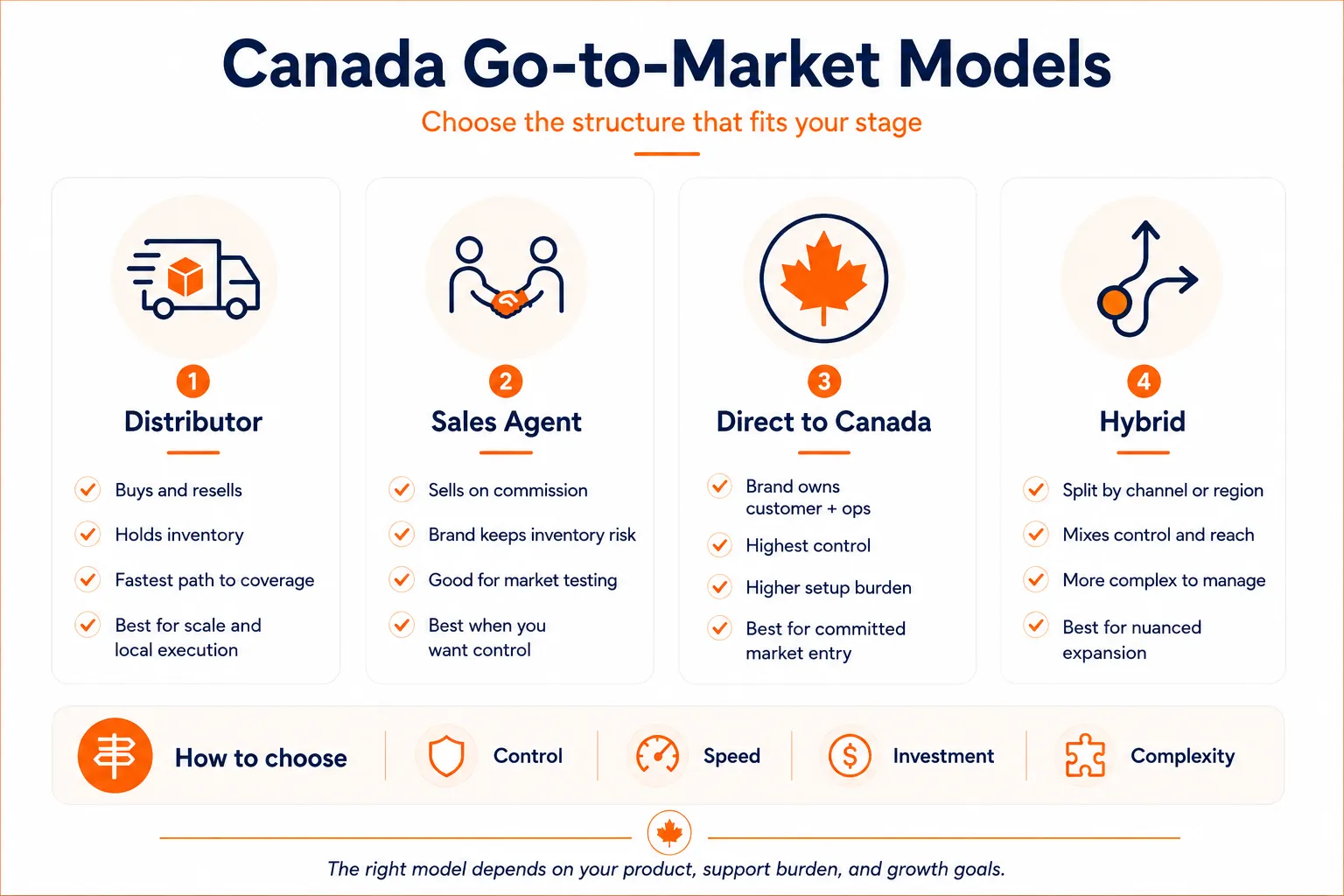
Although the distributor-versus-agent comparison is the common framing, four models are actually in play:
- Distributor — a local reseller and operator.
- Sales agent — a commercial representative compensated through commission or a similar arrangement.
- Direct — the manufacturer retains Canadian commercial and operational responsibility itself.
- Hybrid — responsibilities divided by channel, region or stage.
How the Models Allocate Responsibility
Inventory and operations
- Inventory — Distributor: typically purchases and holds Canadian stock, though not in every structure. Agent: the manufacturer retains ownership and location of inventory.
- Importation — The importer structure must be defined contractually and operationally. A distributor may act as importer in some models, but this is not automatic; under an agent model, importation normally remains the manufacturer's responsibility unless another arrangement is established.
- Warehousing and fulfilment — Distributor: typically fulfils domestically from Canadian stock. Agent: fulfilment usually remains with the manufacturer or a third party the manufacturer manages.
- Returns and customer service — Distributor: generally handled locally. Agent: generally flow back to the manufacturer.
Customers and revenue
- Customer invoicing — Distributor: typically invoices Canadian customers directly. Agent: customers are typically invoiced by the manufacturer.
- Customer relationship — Distributor: typically manages much of the day-to-day customer relationship. Agent: introduces and manages accounts commercially while the manufacturer transacts.
Market development and control
- Market development — Distributor: an active market-development distributor invests in building demand and channels; a wholesale-style distributor may not. Agent: focuses on selling into accounts; broader market development usually stays with the manufacturer.
- Pricing control — Distributor: manufacturer influence is indirect and set by agreement. Agent: the manufacturer typically retains direct control of pricing.
Risk, compensation and scale
- Commercial risk — Distributor: carries inventory and receivables risk locally. Agent: most commercial risk remains with the manufacturer.
- Manufacturer involvement — Distributor: lower day-to-day operational involvement. Agent: substantially higher.
- Compensation — Distributor: earns through resale margin. Agent: earns through commission.
- Scalability — Distributor: scales through the partner's operation. Agent: typically scales with the manufacturer's own operational capacity behind the agent.
Where products are medical devices, MDEL and MDL responsibilities depend on product classification and the proposed importer/distributor structure — see MDEL vs. MDL in Canadian medical-device distribution.
When a Distributor May Fit Better
- Domestic inventory creates commercial value — Canadian delivery expectations, returns handling or channel requirements make cross-border fulfilment a persistent friction point.
- Customers need local support before and after purchase, in a category that requires explanation.
- The manufacturer does not want to operate Canadian logistics, invoicing and service directly.
- Some retail, professional or institutional channels may prefer or require domestic supply depending on procurement and category.
- The market needs sustained development, not just coverage.
When an Agent May Fit Better
- The manufacturer wants to retain direct control of pricing, customers and brand experience.
- Order volumes are large and concentrated — a small number of significant accounts rather than broad consumer demand.
- The manufacturer already has, or is willing to build, the operational capacity to serve Canada directly.
- The priority is commercial introductions and account development rather than operating infrastructure.
When Direct May Fit Better
- Order volume is low and the ecommerce model is simple.
- Cross-border fulfilment is economical for the product, with low return and support burden.
- The manufacturer has Canadian capability internally.
- Canadian channel complexity is limited.
For the inventory side of that decision, see Canadian warehousing vs cross-border fulfilment.
Hybrid Arrangements
Real-world structures often mix the models: an agent for institutional accounts alongside a distributor for consumer channels; a distributor for one region or channel and direct sales elsewhere; or arrangements that begin commission-based and convert to distribution once Canadian volume justifies domestic inventory. Hybrid structures can work when customer ownership, channels, inventory, pricing and responsibilities are documented clearly.
Which Model Fits? Five Questions
- Who should own Canadian inventory, and where should it physically sit?
- Who should own the Canadian customer — invoicing, relationship and data?
- Who can operate fulfilment, returns and support effectively?
- How much market development does the product actually require?
- How much direct control does the manufacturer want to retain?
Directionally: more local operating responsibility leans toward a distributor; more manufacturer control leans toward direct or an agent; split needs may support a hybrid. This is directional, not prescriptive — who is responsible for building demand, what budget stands behind it, how performance is measured and how exit is handled all belong in the agreement itself.
Why Category Complexity Matters
The more explanation a product needs, the more the operational side of the relationship matters. Specialized products — adaptive, accessibility and rehabilitation categories among them — often depend on education, professional awareness and responsive support. Those functions sit naturally with a partner operating in the market. A commission structure that rewards closing orders, without local operational responsibility, can leave the hardest parts of a specialized launch unowned.
Why Canada Can Expose the Difference
In a large home market, a manufacturer can sometimes compensate for a weak representation model with its own operational strength. Canadian geography, delivery economics, language requirements, customer expectations and channel structure can make responsibility allocation more consequential: a national market with concentrated population centres, distinct customer expectations and French-language considerations in Quebec. The model you choose determines who absorbs that complexity — you, or your partner.
Quebec's Charter of the French Language establishes French-language requirements for product inscriptions, packaging and accompanying materials, subject to applicable exceptions and product-specific rules. International manufacturers should confirm the requirements that apply to their products before launch.
Commercial structures vary and should be documented appropriately, with professional legal and tax advice where necessary.
The Next Step
See how Inclusia approaches Canadian distribution, how Canadian warehousing and fulfilment supports either model, and what the path looks like on entering the Canadian market. If you are weighing the models for an adaptive or accessibility product, tell us what you are trying to accomplish in Canada.
Inclusia Brands writes from direct Canadian distribution, specialized ecommerce and market-entry operating experience. The comparisons above are commercial operating perspective, not legal advice.
Evaluating Canadian Distribution?
If your company has already built a differentiated product and is evaluating Canada, explore how Inclusia approaches Canadian distribution.
How Canadian Distribution WorksSources & References
- Customs Notice 25-01: Non-Resident Importers — Canada Border Services Agency
- Charter of the French Language, s. 51 (CQLR c. C-11) — LégisQuébec, Gouvernement du Québec
- Regulation respecting the language of commerce and business (CQLR c. C-11, r. 9) — LégisQuébec, Gouvernement du Québec
Related Insights
Evaluating the Canadian Market?
If your company has built a differentiated adaptive, accessibility, rehabilitation or inclusive-living product, tell us what you are looking to accomplish in Canada.