Canadian Warehousing vs Cross-Border Fulfilment
When Canadian inventory changes customer experience, returns, delivery and operating economics — and when cross-border fulfilment may still make sense.
Key Takeaways
- Cross-border fulfilment suits early validation; Canadian inventory suits the stage where friction, returns and channels start costing real money.
- Border friction shows up as delivery variability, duty and tax handling, and international return costs that can materially affect unit economics.
- Canadian inventory can improve access to channels where domestic replenishment or procurement is important, and changes delivery, returns and support.
- Decide using landed cost, margin, return rates, urgency, support burden, channel requirements and demand signals — not a revenue threshold.
- Specialized channel requirements can make domestic inventory more valuable earlier than ecommerce volume alone would suggest.
In This Guide
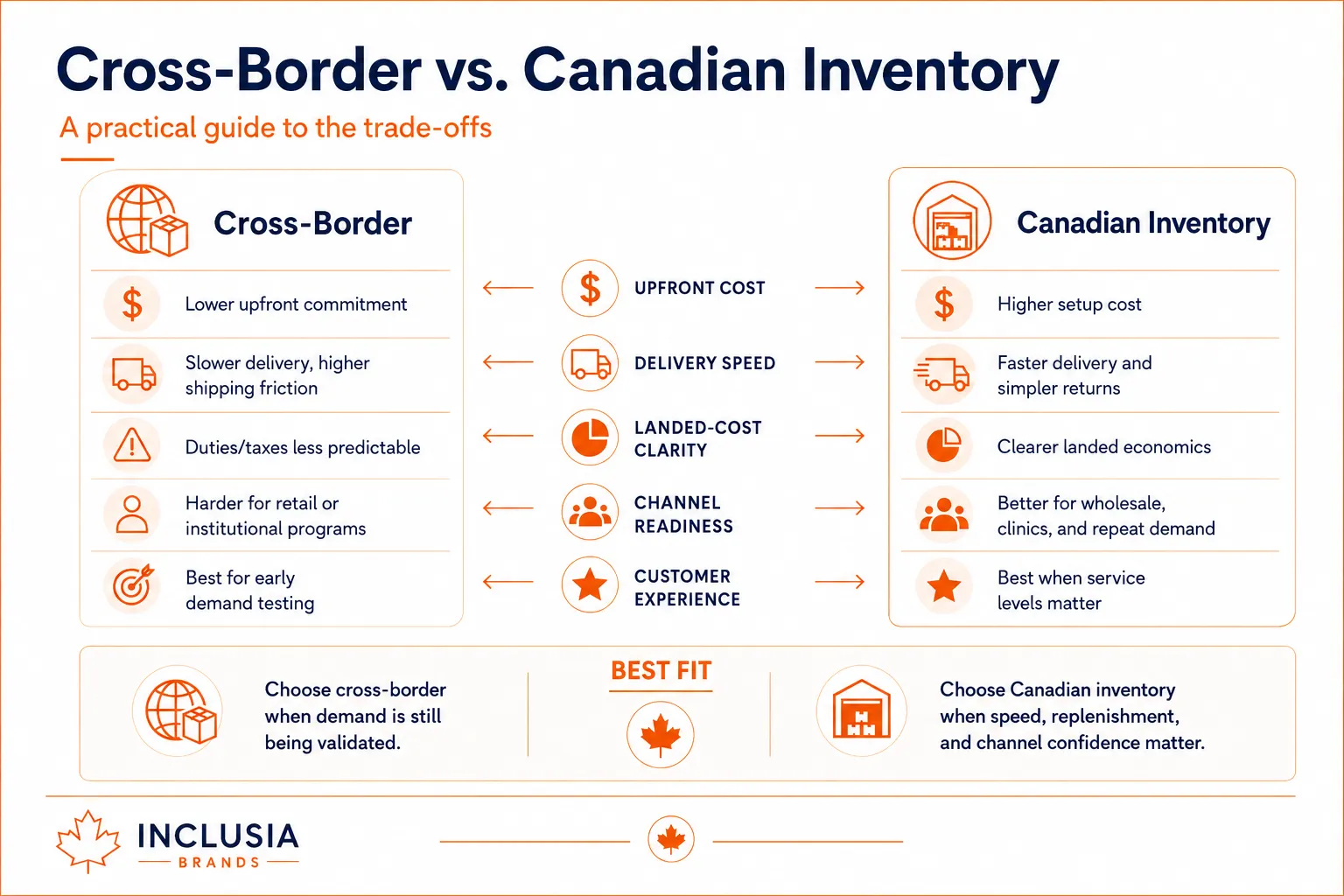
There is no universal answer to whether an international brand should hold inventory in Canada. Cross-border fulfilment can be an appropriate way to validate Canadian demand with limited commitment. Canadian inventory becomes more attractive as customer expectations, returns volume, channel requirements and order economics make cross-border friction increasingly costly. The practical question is not which model is better — it is which stage your Canadian business is in, and which channels it depends on.
The Cross-Border Model
Fulfilling Canadian orders from outside the country, most often from the United States, is how many brands first meet Canadian demand.
Where it helps
- Lower initial commitment — no Canadian inventory purchase, warehousing arrangement or forecasting burden before demand is proven.
- Centralized stock — one inventory pool serves multiple markets while volumes are small.
- Simpler early validation — existing operations serve the first Canadian orders while the brand learns whether and where demand exists.
Where it strains
- Delivery variability — longer and less predictable transit than domestic fulfilment.
- Border friction — customs processing and the handling of duties and taxes add cost and complexity. How these costs are allocated varies by arrangement, and unexpected landed costs, unclear delivery timing or complex returns can create purchase friction.
- Returns complexity — international return costs can materially affect unit economics, particularly for lower-margin or fit-sensitive products.
- Channel limitations — some Canadian retailers, professional channels and institutional buyers may require or strongly prefer domestic supply depending on procurement, product and service needs. Cross-border fulfilment can therefore limit access to certain channels.
One trade note worth internalizing early: cross-border economics depend on tariff classification, origin, applicable tariff treatment, freight, brokerage and the import structure. The country an order ships from does not by itself determine duty treatment — see CBSA, Proof of Origin of Imported Goods.
The Canadian Inventory Model
Holding stock in Canada changes both the customer experience and the operating economics.
What it can enable
- Domestic delivery — can provide faster and more predictable delivery than a cross-border model.
- Workable returns — a domestic return path that keeps customer service economically workable.
- Local support — service and replacement handled inside the market.
- Channel readiness — the ability to supply retailers, professional channels and institutions that require or prefer domestic sourcing.
- A more predictable customer experience — which, in specialized categories, is part of the product.
What it costs
- Inventory commitment — working capital tied up in Canadian stock, with the forecasting risk that follows.
- Warehousing and handling — a domestic operation to fund directly or through a partner.
- Replenishment lead time and aging — reorder cycles, seasonality and the risk of slow-moving stock.
- Operational complexity — planning, replenishment and stock management across another border.
A Decision Framework
Weigh the two models against your product and stage rather than in the abstract:
- Landed cost — what the product actually costs to put in a Canadian customer's hands under each model.
- Product margin — can the margin absorb cross-border shipping and returns, or does friction consume it?
- Size and weight — bulky or heavy products feel cross-border shipping costs first.
- Return frequency — the higher the category's return rate, the sooner domestic returns matter.
- Delivery urgency — products bought at a moment of need are especially sensitive to delivery time and predictability.
- Customer-support burden — categories with heavy pre- and post-purchase questions benefit from local handling sooner.
- Reorder lead time — long replenishment cycles raise the stakes of forecasting under either model.
- Seasonality — concentrated seasons raise the cost of stockouts and mis-timed replenishment.
- Channel requirements — where retail, professional or institutional channels are part of the route to market, domestic supply may be required or strongly preferred depending on procurement and category.
- Canadian demand consistency — sustained orders, not a spike, justify committing stock.
- Regulatory and import requirements where relevant — regulatory and licensing requirements are evaluated as part of each potential Canadian distribution partnership.
When to Move Inventory Into Canada
Qualitative indicators matter more than any revenue threshold:
- Canadian customers are ordering repeatedly, and delivery or returns friction is visibly costing conversions or reviews.
- A Canadian channel you want — retail, professional, institutional — makes domestic stock more important earlier in the market-development process.
- Cross-border returns are forcing bad choices between absorbing losses and disappointing customers.
- Customer-service and warranty issues increasingly need local handling.
- Inventory economics support local stock, and forecast confidence is improving.
Inventory should follow the commercial model, not precede it automatically.
Ecommerce Is Only One Part of the Decision
It is tempting to let ecommerce volume alone dictate the inventory decision. Online demand is a useful signal, but it does not prove retail or professional demand — and return patterns and support questions often inform the inventory decision as much as order counts do. For specialized products, channel strategy can make domestic inventory more valuable earlier than online volume suggests: if clinical evaluation, professional recommendation or specialty-retail presence is part of how the product reaches its buyer, those channels may favour domestic availability earlier than ecommerce volume alone would justify — and the ecommerce business then benefits from the same inventory. Canadian ecommerce itself can operate cross-border or domestically depending on economics; see Canadian ecommerce distribution. This is one reason inventory decisions belong inside a broader route-to-market plan rather than a fulfilment spreadsheet.
The Next Step
See how Canadian distribution works, how Inclusia connects one inventory position to multiple channels, and what the path looks like on entering the Canadian market. For the model comparison behind this decision, see Canadian distributor vs sales agent. When you are ready to act on the inventory decision, see how Canadian warehousing and logistics works in practice — or tell us what you are trying to accomplish.
Inclusia Brands writes from direct Canadian distribution, specialized ecommerce and market-entry operating experience. The frameworks above are commercial operating perspective, not customs or legal advice.
Evaluating Canadian Distribution?
If your company has already built a differentiated product and is evaluating Canada, explore how Inclusia approaches Canadian distribution.
How Canadian Distribution WorksSources & References
- Guide to Importing Commercial Goods into Canada — Canada Border Services Agency
- Customs Notice 25-01: Non-Resident Importers — Canada Border Services Agency
Related Insights
Evaluating the Canadian Market?
If your company has built a differentiated adaptive, accessibility, rehabilitation or inclusive-living product, tell us what you are looking to accomplish in Canada.